A quick search for an Epworth Sleepiness Scale PDF returns hospital handouts, slide decks, student theses and forum attachments. They look alike, and they aren’t the same. One version changes “dozing” to “feeling tired”. Another drops the instruction line that defines the time frame. A third prints the interpretation bands directly under the questions.
Those differences matter, because the scale’s published reference ranges assume the standard wording. Say a clinic hands out a copy where item 5 reads “lying down in the afternoon” without the words “when circumstances permit”. Patients who never get the chance to lie down may answer 0 for the wrong reason, and the clinic’s average score drifts away from the published 0 to 10 normal range without anyone noticing.
Get the sample copy
The sample copy below is a reference for what the standard adult questionnaire looks like. It’s the 1997 version of the ESS, the standard version for most adults.
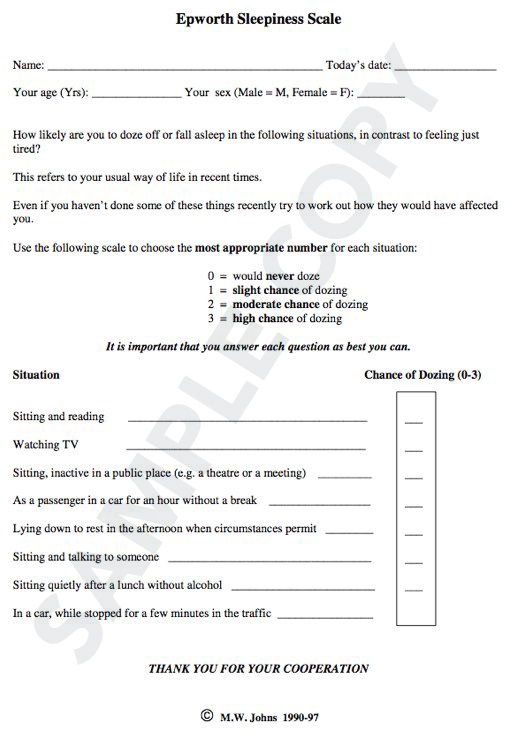
A sample copy is for reading and teaching. Using the questionnaire with respondents, in a study, a clinic or a product, requires a licence. The licensing page explains who pays and how Mapi Research Trust issues licensed copies.
How to recognise a genuine ESS form
A genuine form can be checked in about a minute. Eight points cover most altered copies:
- The title is “Epworth Sleepiness Scale” and the form carries the copyright line (© MW Johns, 1990–1997 for the adult version).
- It contains exactly eight situations.
- Each situation has the same four answers: would never doze (0), slight chance (1), moderate chance (2) and high chance (3).
- The instructions ask about “usual way of life in recent times”, and they tell respondents to work out how a situation would have affected them if they haven’t done it recently.
- There’s no total score interpretation printed on the form. Johns’ guidance is that interpretations shouldn’t be shown to respondents while they answer, because that could influence their answers.
- The first situation is sitting and reading, and the last is sitting in a parked car in traffic. Reordered or reworded items point to an unofficial copy.
- A total line at the bottom adds the eight item-scores, and the maximum is 24.
- For ESS-CHAD forms, item 3 mentions a classroom at school and the recall period is “the last month”.
A copy that fails two or three of these checks is better replaced than repaired. The point isn’t perfectionism. Scores from a modified form can’t be compared with the literature, so the extra care protects the one thing the ESS offers: a shared yardstick.
Which version to use
| Respondent | Version | Where to get it |
|---|---|---|
| Adults who read English | ESS, 1997 version | Mapi Research Trust |
| Children and adolescents | ESS-CHAD (2015) | Mapi Research Trust |
| Other languages | Standardised translation | Mapi Research Trust, see the translations guide |
The ESS-CHAD changes the instructions and some activities so that they fit a young person’s day. Most children over about nine years and most adolescents can answer it alone. Younger children usually need a parent.
Printing and scoring a paper form
Paper works well for waiting rooms and research visits. Three habits keep the data clean:
- Print a single page, so respondents don’t skip a back side. A missing item makes the ESS invalid, because item scores can’t be estimated.
- Keep the answer boxes large enough for a clear 0, 1, 2 or 3. If someone writes half a point, the half is added and a total ending in .5 is rounded up (Dr Johns’ scoring rule).
- Score the form afterwards with the ESS calculator or by hand, then record the total and the band.
Why bother with rules about half points? Because two staff members scoring the same form differently would add noise that has nothing to do with the patient. A written rule removes it.
What a PDF can’t tell you
An ESS PDF measures sleepiness on a single scale and nothing more. It doesn’t diagnose, and it doesn’t identify the cause of a high score. The interpretation guide explains what each band means and what the scale can’t show.
Frequently asked questions
Where can I download the Epworth Sleepiness Scale PDF?
A sample copy of the adult ESS is available on this page as a PDF. Licensed copies for use in studies, clinics and products come from Mapi Research Trust, which handles licences and translations.
Is the Epworth Sleepiness Scale PDF free?
The sample copy is free to read. Use of the questionnaire needs a licence whether or not a fee is payable. Individual researchers and clinicians pay no fee, while corporations, companies and governments pay AU$500 per year.
Which version of the ESS should I print?
The 1997 version is the standard version for most adults. The ESS-CHAD is the version for children and adolescents. If the respondent doesn't read English, a licensed translation avoids wording problems.
Can I edit the Epworth Sleepiness Scale PDF?
Only spelling variants are acceptable. Other edits change what each item asks, which makes your scores hard to compare with published reference ranges.